
Breaking Down the WordPress Website Redesign Cost in 2026
When evaluating proposals for a digital overhaul, the wide price variations can feel baffling. In 2026, web design quotes reflect vastly different scopes of work, levels of strategic planning, and technical execution.
WordPress itself powers over 40% of the web. While the core software remains open-source and free, turning that software into a reliable, high-converting digital front door requires specialized development, design, and integration expertise. To understand where your budget goes, it helps to review the primary redesign tiers across the industry:
| Project Tier | Typical Cost Range | Typical Turnaround | Primary Inclusions & Deliverables |
|---|---|---|---|
| Basic Template Refresh | $1,500 – $3,500 | 2 – 4 Weeks | Pre-built commercial theme, basic visual styling, light copy insertion, simple contact forms, baseline mobile check. |
| Semi-Custom Growth Build | $5,000 – $15,000 | 6 – 10 Weeks | Custom block layout design, user flow optimization, technical SEO migration, CRM/booking integration, core web vitals optimization. |
| Fully Custom Architecture | $15,000 – $50,000+ | 10 – 16+ Weeks | Custom UI/UX wireframing, bespoke theme coding, advanced schema markup, HIPAA/EHR portal integrations, deep workflow automation. |
To get a clearer sense of how baseline project rates are determined across industries, review our small business website cost guide.
Template Customization vs. Custom Development Tiers
The foundational fork in the road is deciding between adapting an off-the-shelf theme and investing in custom development.
A template-based refresh typically starts by purchasing a commercial theme ($60 to $200) and using visual page builders. For a solo practitioner or a new venture, this keeps upfront cash outlays minimal. However, commercial multi-purpose themes often come bundled with dozens of unused scripts, sliders, and bloated stylesheets. Over 12 to 24 months, these bloated themes can create significant technical debt, slowing down page speed and complicating routine security patches.
Custom development, in contrast, utilizes tailored WordPress block patterns (using modern Gutenberg blocks or lightweight component frameworks). This approach builds only what your practice needs. There is no extraneous code bogging down mobile load times, which provides cleaner code architecture, easier ongoing edits for your staff, and improved long-term reliability.
Small Business WordPress Website Redesign Cost Factors
For local practices—such as physical therapy clinics in Crozet, dental offices in Albemarle County, or chiropractic centers in Charlottesville—a website must do more than look pretty. It functions as an automated patient intake channel.
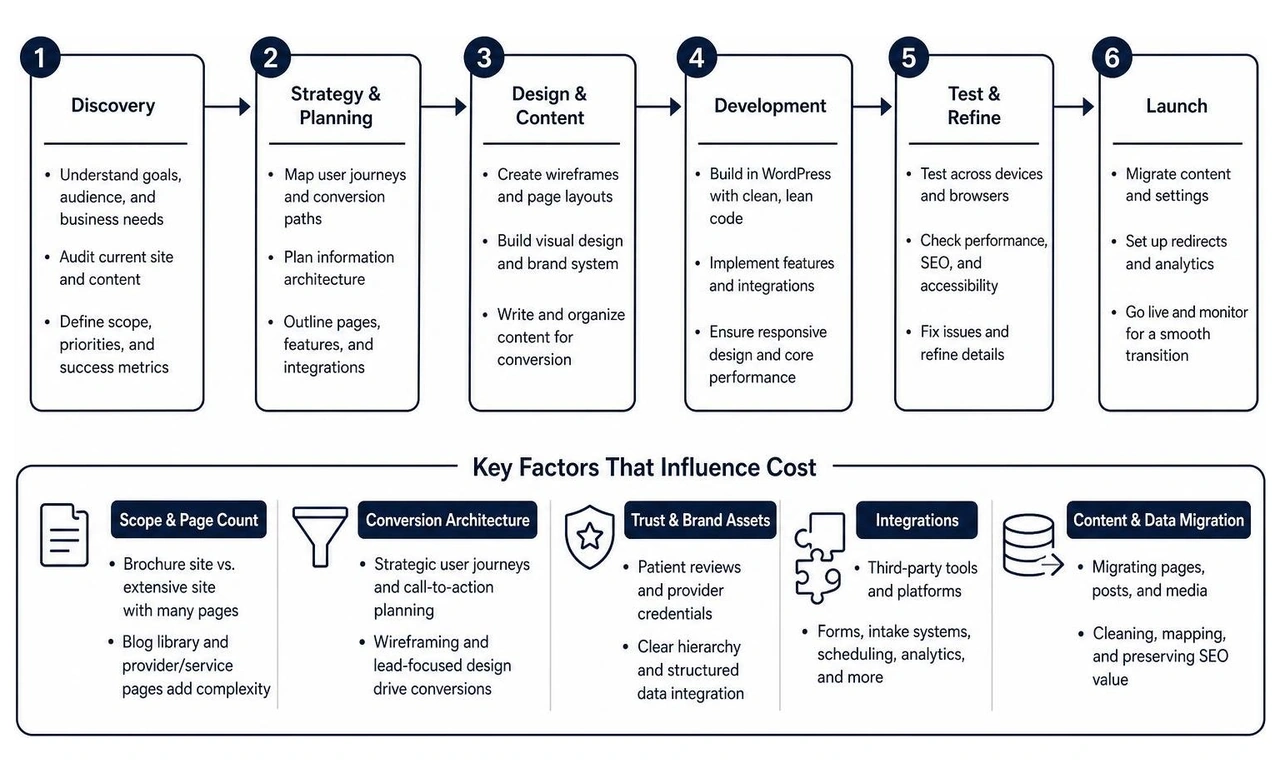
Your project cost will naturally reflect the complexity of your practice's digital ecosystem:
- Service Silo Depth: A single generalized "Services" page takes far less time to build than dedicated, optimized landing pages for specific treatments (e.g., dry needling, pediatric dentistry, or vestibular rehab).
- Conversion Architecture: Building strategic conversion paths requires thoughtful wireframing. Investing in dedicated lead generation website design services ensures every touchpoint guides the patient toward taking action.
- Brand Positioning & Trust Assets: Integrating verified patient reviews, provider credentials, and interactive service menus demands clean visual hierarchy and structured data.
Agency vs. Freelancer Pricing Models
Who you hire directly shapes both the quote and the project outcome.
- Independent Freelancers ($1,000 – $5,000): Freelancers generally carry low overhead, making them an affordable option for simple updates. However, a single freelancer must wear every hat: graphic designer, PHP developer, copywriter, and SEO specialist. If they excel at visual design, technical aspects like redirect mapping or database optimization might be overlooked.
- Integrated Digital Growth Agencies ($5,000 – $20,000+): Full-service agencies bring dedicated specialists to discovery, UX design, backend development, conversion copywriting, and technical SEO. This collaborative model eliminates single-point-of-failure risks and provides higher accountability, ensuring your redesigned site functions seamlessly within your broader operational pipeline. For context on how these platforms have evolved, the WordPress ecosystem continues to expand its block-based editing capabilities.
Core Drivers That Inflate or Reduce Your Redesign Budget
When examining why two seemingly similar practices receive different proposals, the variance almost always comes down to technical depth, data migration, and third-party integrations.
Before committing to a scope of work, reviewing an established website redesign planning guide helps clarify your must-have operational requirements versus secondary cosmetic wants.
Scope, Page Count, and Dynamic Features
A practice redesigning a 6-page brochure site has vastly different labor requirements than an established medical group with 45 provider bios, extensive clinical service pages, and an educational blog library.
Key functional scope drivers include:
- Performance Optimization: Achieving sub-two-second load times requires meticulous asset caching, script deferral, and media compression. Utilizing specialized website speed optimization services small business practices ensures the site meets modern performance expectations.
- Accessibility Compliance (WCAG 2.1 AA): Ensuring contrast compliance, keyboard navigation, and screen-reader compatibility is essential for health and wellness providers serving diverse patient communities.
- Dynamic Content Filtering: Features like searchable doctor directories, location finders for multi-clinic practices, or filterable condition libraries require custom post types and relational database queries, which expand development time.
Content Migration, Technical SEO, and URL Redirects
One of the largest hidden risks in any website redesign is the accidental loss of search visibility. When page URLs, header structures, and internal links change without careful mapping, search engines lose their historical context.
A comprehensive redesign scope must account for:
- 301 Redirect Mapping: Every legacy URL must be cataloged and mapped to its new counterpart. Following a rigorous website migration redirect map guide prevents broken 404 links and preserves search equity.
- On-Page Metadata Preservation: Title tags, meta descriptions, image alt attributes, and heading hierarchies must be migrated and enhanced rather than discarded.
- Local Schema Implementation: Embedding structured JSON-LD data for
MedicalBusiness,Physician, and geographic service areas helps search engines accurately interpret your practice details.
Modern Integrations: Online Booking, Portals, and AI Automation
In 2026, a static contact form is no longer enough to support an active local practice. Modern patients expect immediate scheduling and responsive communication.
- Electronic Health Record (EHR) & Booking Portals: Integrating platforms like Jane App, WebPT, Modento, or Cliniko requires clean embed styling, secure external linking, or API configuration ($1,000 to $3,000 per custom integration).
- Intake Automation & CRM Routing: Connecting new inquiries directly to your practice management system or CRM reduces manual front-desk data entry.
- AI Receptionists & Missed-Call Recovery: Modern growth platforms integrate intelligent conversational agents that instantly capture after-hours inquiries, answer routine FAQs about insurance, and route booking links directly to callers' phones.
Hidden and Ongoing Expenses: Calculating the 3-Year Total Cost of Ownership
The launch invoice represents only the initial phase of your website investment. A website functions like a high-performance clinical tool—it requires ongoing maintenance, security monitoring, and regular updates to perform reliably.

To budget effectively, practice managers must evaluate the 36-month total cost of ownership (TCO):
| Cost Component | Year 1 (Build + Upkeep) | Year 2 (Maintenance) | Year 3 (Growth & Updates) | 3-Year Cumulative Total |
|---|---|---|---|---|
| Initial Redesign Build | $7,500 – $15,000 | $0 | $0 | $7,500 – $15,000 |
| Managed WordPress Hosting | $360 – $600 | $360 – $600 | $360 – $600 | $1,080 – $1,800 |
| Premium Plugin Licenses | $300 – $800 | $300 – $800 | $300 – $800 | $900 – $2,400 |
| Security & Routine Maintenance | $1,200 – $3,600 | $1,200 – $3,600 | $1,200 – $3,600 | $3,600 – $10,800 |
| Conversion Optimization & Content | $1,500 – $3,000 | $1,500 – $3,000 | $1,500 – $3,000 | $4,500 – $9,000 |
| Estimated 3-Year Total | $10,860 – $23,000 | $3,360 – $8,000 | $3,360 – $8,000 | $17,580 – $39,000 |
Ongoing WordPress Website Redesign Cost and Maintenance
Neglecting ongoing upkeep can turn an initial investment into a liability. WordPress core updates, theme updates, and third-party plugin patches are released weekly to fix vulnerabilities.
A dependable monthly maintenance agreement covers:
- Automated Daily Backups: Storing off-site, cloud-based backups so your site can be restored in minutes if an issue arises.
- Vulnerability Monitoring: Proactive scanning to prevent malware injections and security breaches.
- Staging Environment Testing: Testing plugin and theme updates on a private clone of your site before pushing changes live, ensuring checkout and booking systems never break.
Enlisting professional website maintenance services small business safeguards your brand's digital infrastructure while freeing your administrative team to focus on patient care.
WordPress Website Ownership Costs Over 36 Months
Over a three-year horizon, software licensing and developer dependencies add up. Premium plugins for form routing, SEO management, custom fields, and caching layers typically require $300 to $800 annually in renewals.
Furthermore, unexpected layout breakages or PHP version upgrades require periodic developer hours. When budgeting, allocating an ongoing operational reserve of $150 to $500 per month ensures your digital presence stays modern, secure, and fast without requiring emergency rebuilds.
Frequently Asked Questions About WordPress Redesign Costs
How much should a local service business spend on a WordPress redesign?
For most independent health, wellness, and care practices in Central Virginia, a realistic budget lands between $5,000 and $15,000. This budget allows for a tailored, conversion-focused design, technical SEO preservation, mobile performance tuning, and direct integration with your appointment workflows. Projects below $3,000 often rely on pre-built templates that create technical debt, while enterprise budgets exceeding $25,000 are typically reserved for multi-location hospital networks or extensive custom software applications.
How do I redesign my WordPress site without losing search rankings?
Preserving search visibility requires an audit-first approach before touching a single line of code. We maintain search equity by:
- Crawling and cataloging every existing indexed URL.
- Preserving high-performing page URL structures whenever possible.
- Establishing strict 1-to-1 301 redirects for any altered permalinks.
- Migrating on-page metadata, heading structures, and schema markup intact.
- Conducting post-launch crawl audits to verify zero indexing errors or broken internal paths.
Is it cheaper to redesign an existing site or build from scratch?
Redesigning an existing site is almost always more cost-effective than starting from scratch because your practice can repurpose existing copy, high-resolution imagery, and established domain authority. However, if your current site relies on an outdated, broken page builder with severe database bloat, cleanly extracting content into a fresh WordPress installation can sometimes be faster and more economical than patching legacy code.
Strategic Growth for Central Virginia Practices
A website redesign should never be treated as a purely aesthetic expense; it is a foundational investment in your practice's operational workflow and patient acquisition pipeline. When your website seamlessly connects modern design with technical SEO, automated booking, and immediate patient communication, it transforms into an active engine for practice growth.
At STANDBY Local, we diagnose operational bottlenecks before recommending digital solutions. We help appointment-based health, wellness, and care practices throughout Charlottesville, Albemarle County, Crozet, Waynesboro, Staunton, and across Central Virginia build robust digital systems that attract, convert, and retain patients.
If you are ready to evaluate your current digital presence and explore a structured, high-performing redesign, explore our dedicated website redesign services small business solutions.
Take the next step in scaling your practice: book a free growth blueprint call with our team today or reach out at hello@standbylocal.com.