
What Should a Small Business Website Cost in 2026?
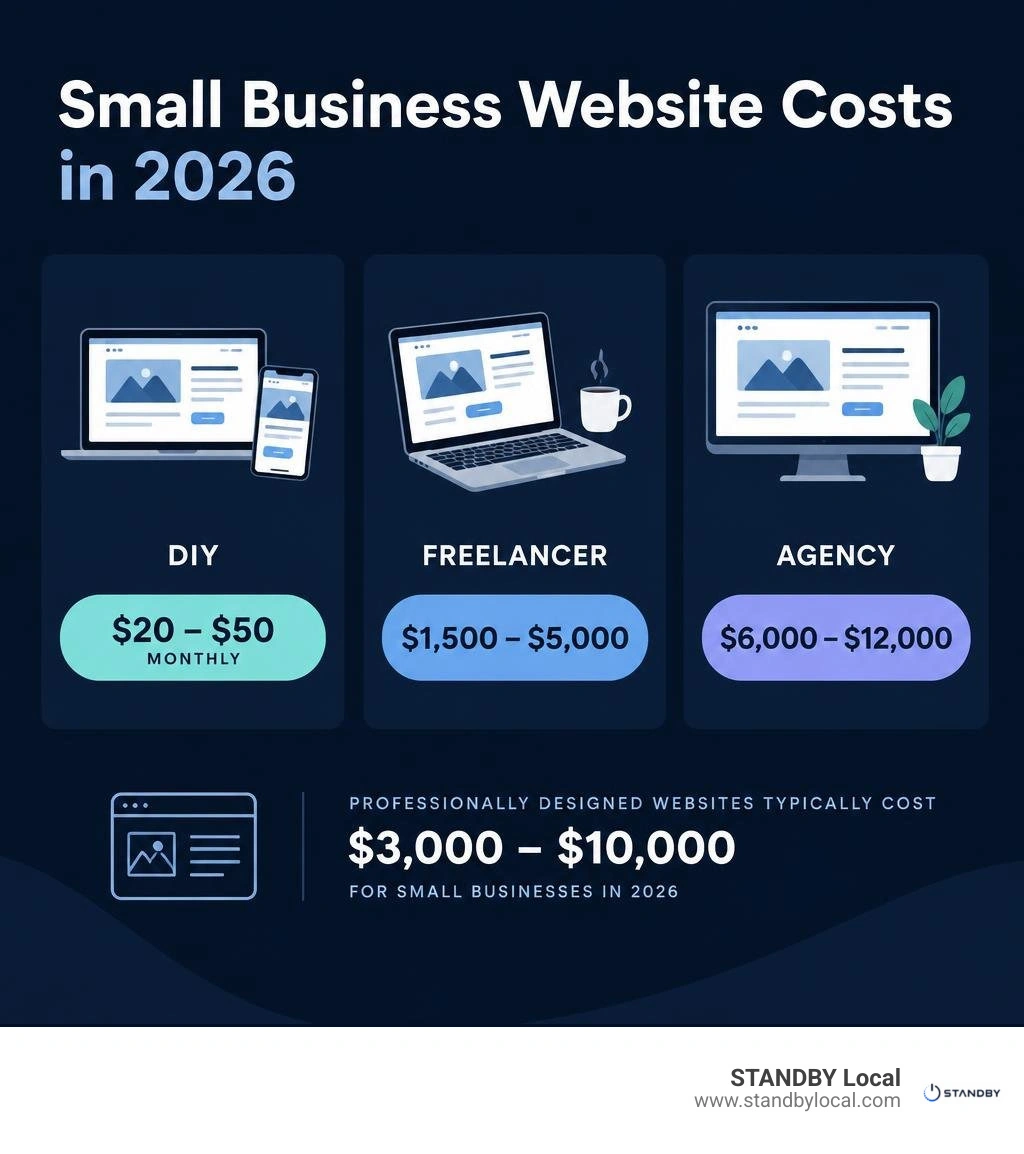
Plan on $3,000-$10,000 for a professionally designed small business website in 2026. A DIY builder typically costs $20-$50 per month, a freelancer-built site often runs $1,500-$5,000, and a boutique agency build commonly costs $6,000-$12,000. These are budgeting ranges, not fixed prices.
For a local service business, the right quote depends on more than page count. Ask what it includes for clear service pages, mobile use, contact forms, local search basics, and support after launch.
I'm Drew Edmondson, founder of STANDBY Local, where I help service businesses weigh the average cost of website design for small business projects against their lead-generation needs. I've also built websites and automated workflows for my own ventures, so I look at both the build price and what it takes to keep a site working.
1. What Is the Average Cost of Website Design for Small Business in 2026?
When you ask five web developers what a new site costs, you will likely get five wildly different answers. One person quotes $800, another quotes $4,500, and an agency estimates $15,000. It is easy to feel confused, but national benchmarks show a clear pattern. Across the United States, most small business owners spend between $3,000 and $10,000 for a professionally designed, responsive website that turns visitors into real phone calls and booked appointments.
According to data compiled by industry analysts at Project Cost Estimator, quotes for identical project scopes can vary by up to 300%. This spread usually comes down to who does the work, the level of strategic planning involved, and how much custom functionality your practice requires.
Today, roughly 83% of small businesses operate an active website. Furthermore, 40% of small business owners report that organic search engines represent their single largest source of customer inquiries. If your digital front door is clunky, slow, or difficult to navigate on a smartphone, you leave valuable community members searching for the next clinic down the street.
To help make sense of these numbers, here is how the primary design routes compare across typical build costs, production timelines, and overall focus:
| Build Route | Typical Upfront Investment | Build Timeline | Strategic & Conversion Focus | Best Fit For |
|---|---|---|---|---|
| DIY Website Builders (Wix, Squarespace) | $20 – $50 / month ($200 – $600 / year) | 1 – 3 weeks | Low (Template-driven; self-directed) | Solo pre-revenue startups testing an idea |
| Independent Freelancer | $1,500 – $5,000 | 3 – 6 weeks | Moderate (Visual layout & basic technical setup) | Established solo practitioners with existing copy |
| Boutique Growth Agency | $6,000 – $12,000 | 6 – 10 weeks | High (UX research, conversion architecture, local SEO) | Established multi-provider clinics driving consistent revenue |
For a deeper dive into these budgeting tiers, you can review our small business website cost guide to calculate what fits your operational baseline.
Average Cost of Website Design for Small Business Using Freelancers vs. Agencies
Deciding between a solo freelancer and a specialized boutique agency is often the first big decision. Across the country, freelance web designers charge a median rate of $92.75 per hour, with general hourly rates falling between $50 and $150 per hour. When billing on a fixed project basis, a skilled independent contractor typically charges $1,500 to $5,000 for a functional 5- to 10-page website.
Working with a freelancer offers direct communication and lower overhead. However, a single contractor must wear every hat: graphic designer, frontend developer, copywriter, and technical SEO specialist. If your project hits a technical snag or you need an integrated intake system, you may find that their specialty covers visual styling but lacks backend automation expertise.
Boutique agencies charge between $6,000 and $12,000 because they bring a multi-disciplinary team to your project. This price includes dedicated project management, custom user experience (UX) design, technical search optimization, and integration with operational tools like scheduling calendars and digital patient intake forms. For clinics that cannot afford downtime or missed calls, partner agencies providing specialized small business website design services deliver accountability, structured testing, and long-term diagnostic support.
How Scope and Platform Determine the Average Cost of Website Design for Small Business
Your choice of content management system (CMS) directly influences both upfront design labor and ongoing maintenance costs. Here is how the most common platforms stack up:
- WordPress (Custom or Theme-Based): Powering over 43% of the web, WordPress remains the industry standard for content flexibility and search indexing. Professional WordPress builds typically range from $3,000 to $9,000. While open-source software avoids proprietary licensing fees, it requires routine plugin management and active security patching.
- Webflow: Known for clean code export and visual design precision, Webflow builds generally run between $4,000 and $10,000. It offers fast load speeds and managed hosting, though advanced custom integrations require specialized developer expertise.
- Shopify: If your business sells physical products, digital wellness plans, or specialized equipment, Shopify is the leading ecommerce platform. Small catalog builds usually range from $5,000 to $12,000, driven by checkout customization and inventory configuration.
- Wix / Squarespace: While cost-effective for simple visual portfolios, these hosted tools range from $200 to $1,500 when set up by a designer. However, they can present limitations when attempting complex medical practice automations or custom database lookups.
Investing in tailored website builds ensures your technology stack matches your actual business workflow, rather than forcing your staff to work around generic software limitations.
2. Pricing Tiers by Business Model: From Local Clinics to Multi-Service Practices
A local private physical therapy practice in Albemarle County has very different technical needs than a regional multi-location dental group or a nationwide retailer. Website pricing reflects this complexity.

Across the industry, pricing breaks down predictably when categorized by functional business models:
Starter Informational Websites for Solo Practices and Practitioners
- Typical Price Range: $2,500 – $4,500
- Scope: 5 to 7 core pages (Home, About Us, Services, Practitioner Bio, Contact/Directions).
- Core Objective: Establish professional credibility, display operating hours, outline clinical focus areas, and provide a direct click-to-call phone number and simple message form.
For a solo mental health counselor or independent chiropractor in Crozet or Waynesboro, a clean, rapid-loading informational site provides everything needed to validate local referrals. The budget goes primarily into clear typography, mobile responsiveness, and foundational local search setup.
High-Converting Booking and Intake Platforms for Multi-Provider Clinics
- Typical Price Range: $6,000 – $14,000
- Scope: 10 to 20+ specialized pages, including individual practitioner profiles, comprehensive condition guides, interactive appointment schedulers, secure digital intake forms, and multi-location directories.
- Core Objective: Automate patient acquisition, eliminate front-desk phone bottlenecks, capture leads after hours, and integrate directly with practice management software.
For busy wellness centers, physical therapy clinics, and medical practices throughout Central Virginia, your website must serve as an active administrative engine. When you implement conversion-focused design with integrated lead generation website design services and specialized conversion rate optimization services small business, your digital platform reduces manual data entry and helps convert casual browsers into confirmed appointments.
3. The Real Cost Drivers: Why Estimates Vary So Widely in the US
Why does an agency in a major metropolitan hub quote $25,000 for a website, while an experienced regional agency in Central Virginia delivers a comparable build for $7,500? Geographic overhead plays a role, with coastal urban agencies billing between $150 and $300+ per hour, while mid-tier regional firms bill at $90 to $150 per hour. However, the deepest variance stems from the level of strategic research included before a single line of code is written.
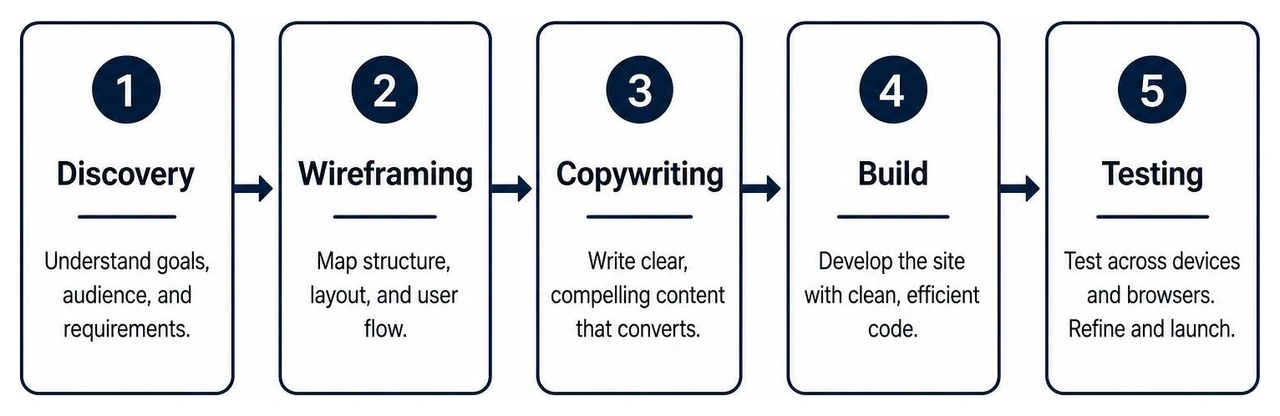
Selecting the right partner requires understanding what is included under the hood. As detailed in our guide on how to choose web design agency partners, skipping strategic discovery is often why low-cost websites fail to generate real patient inquiries.
Custom UX Design, Positioning, and Strategic Copywriting
A template site simply inserts placeholder text into pre-existing visual boxes. A strategic website, by contrast, starts with patient journey mapping:
- What symptoms or questions bring a visitor to this page?
- What specific trust signals (certifications, real photos, patient reviews) resolve their hesitation?
- How quickly can they verify insurance acceptance, office location, and next steps?
Professional copywriting accounts for $1,000 to $3,500 of a project's overall investment, but it directly dictates conversion performance. Utilizing specialized website copywriting services charlottesville ensures your message speaks to the distinct needs of local residents across Albemarle, Fluvanna, Greene, and Nelson counties, creating clear calls to action that encourage prospective patients to take the next step.
Compliance, Accessibility Standards, and Technical Search Foundations
For healthcare and wellness providers, accessible design is both an ethical responsibility and a critical legal safeguard. Building a website that aligns with Americans with Disabilities Act (ADA) requirements and Web Content Accessibility Guidelines (WCAG 2.1 Level AA) involves deliberate contrast choices, keyboard navigation pathways, screen-reader markup, and accessible form labels.
You can learn more about these requirements in our accessible conversion website guide. Integrating these safeguards upfront or scheduling regular website accessibility audit services small business prevents expensive retroactive development fixes later.
Furthermore, a sound technical foundation requires clean URL taxonomies, schema markup for local service businesses, mobile-first performance tuning, and accurate location indexing. These structural elements ensure search engines can properly discover and categorize your services across Charlottesville, Staunton, Harrisonburg, and surrounding areas.
4. Hidden Ongoing Expenses You Must Budget for After Launch
The cost of launching a website does not end on the day your site goes live. A website is a dynamic software environment that requires regular maintenance, secure hosting, and routine updates to run reliably.

According to industry benchmarks, your initial build represents roughly one-third of the total cost of running a website over a five-year lifecycle. The remaining two-thirds consists of ongoing hosting, software licensing, and operational upkeep.
Here is what small business owners should budget annually to keep their digital infrastructure running smoothly:
| Expense Category | Self-Managed / Basic Route | Professionally Managed Service | Frequency |
|---|---|---|---|
| Domain Name Registration | $15 – $30 | $20 – $50 | Annual |
| Managed Business Hosting | $120 – $360 ($10–$30/mo) | $600 – $1,800 ($50–$150/mo) | Annual / Monthly |
| SSL Certificate (Security) | Free (Let's Encrypt) to $50 | Included in managed hosting | Annual |
| Premium Plugin & Software Licenses | $100 – $400 | Included in agency care plans | Annual |
| Technical Maintenance & Backups | $0 (DIY time investment) | $1,200 – $3,600 ($100–$300/mo) | Ongoing monthly |
| Total Estimated Annual Running Cost | $235 – $840 / year | $1,820 – $5,450 / year | Annual |
Hosting Infrastructure, Security Patches, and Core Software Updates
Cheap $5-per-month shared hosting packs hundreds of websites onto a single server. If another site on that server experiences a traffic spike or security vulnerability, your clinic's booking page can slow to a crawl or go offline completely. Managed hosting environments provide dedicated server resources, automated daily backups, firewall monitoring, and integrated SSL certificates.
Enrolling in comprehensive website maintenance services small business ensures your underlying CMS, server PHP versions, and database tables are tested and updated weekly. This prevents broken checkout flows, form errors, or malware infections from disrupting your daily patient scheduling.
Speed Optimization, Form Quality Assurance, and Tracking Integrity
Page speed directly influences user patience and conversion rates. Industry studies show that over 70% of web designers identify mobile responsiveness and slow loading speeds as the primary reasons visitors leave a site without taking action.
Routine performance maintenance includes:
- Compressing image assets into modern WebP formats.
- Auditing scripts to meet Google's Core Web Vitals standards with website speed optimization services small business.
- Performing routine form quality assurance using a structured website lead form qa local service business guide to verify that phone numbers, booking confirmations, and notification emails reach your staff every time.
5. The ROI Equation: Why Cheap Websites Cost More in the Long Run
When evaluating web design proposals, it is tempting to view the build purely as an expense rather than a revenue-generating asset. However, choosing the lowest bidder often introduces hidden operational bottlenecks that end up costing far more than the initial savings.
Consider this practical comparison:
- Scenario A (Budget Template Site): You spend $800 on a pre-made template. The site receives 1,000 local visitors per month but has confusing navigation and no clear call to action, resulting in a conversion rate of 0.5% (5 booked appointments). If an average new patient value is $400, the site produces $2,000 per month in revenue.
- Scenario B (Strategic High-Converting Site): You invest $6,500 in a custom, conversion-focused design with integrated scheduling. With the same 1,000 monthly visitors, clear positioning and streamlined mobile booking lift the conversion rate to 2.5% (25 booked appointments). At the same $400 patient value, the site produces $10,000 per month in revenue.
That represents an $8,000 monthly difference in practice revenue. The professional website pays for its entire upfront build investment within the first two months of operation. A well-targeted website built around clear patient intent will consistently outperform an expensive, unfocused project every time.
Lost Bookings, Broken Inquiries, and Revenue Leakage
Every time a prospective client encounters a broken button, waits six seconds for a service page to load, or calls an unmonitored line, your practice loses revenue. At STANDBY Local, we diagnose these operational friction points across your entire patient acquisition pipeline.
Integrating your website design with automated solutions—such as an AI receptionist for 24/7 missed-call answering, automated SMS appointment confirmations, and CRM lead routing—ensures that when your marketing brings a visitor to your site, that inquiry turns into a confirmed booking. Evaluating your site against our practical website lead generation checklist helps uncover where your current platform may be leaking qualified inquiries.
The Compounding Financial Burden of Frequent Rebuild Cycles
A $500 template website that is patched together and rebuilt twice over four years ends up costing $1,500 in basic design fees alone. When you factor in lost patient revenue during downtime, emergency developer troubleshooting, and broken search URLs, the real price tag climbs much higher.
A well-architected website built on a robust content framework easily serves a thriving practice for 3 to 5 years with simple cosmetic refreshes. If your current platform has outgrown its initial architecture, following our website redesign planning guide provides a structured roadmap to rebuild without losing hard-earned search visibility or historical patient data.
Frequently Asked Questions About Small Business Website Costs
How much should a local service business spend on a website in 2026?
Most established local service businesses and healthcare practices should budget between $3,000 and $8,000 for a custom, professionally developed website. A common industry rule of thumb is to allocate roughly 2% to 5% of your annual gross revenue toward your foundational digital marketing infrastructure, with your website serving as the central hub of that system.
Can a $500 template website generate steady appointment bookings?
While a $500 template site can establish an initial web presence for a brand-new solo practitioner, it rarely drives consistent appointment volume on its own. Low-cost templates often suffer from slow loading times, generic stock imagery, unrefined messaging, and rigid form layouts that create friction on mobile devices. For a business that depends on new client acquisition, investing in professional UX design and strategic copywriting typically yields a significantly higher return.
What ongoing monthly maintenance costs should a practice expect?
Practice owners should plan for $100 to $300 per month for professional website maintenance, secure cloud hosting, daily backups, automated security monitoring, and regular software updates. Budgeting for routine upkeep ensures your digital front door remains fast, secure, and fully operational for every visitor.
Conclusion: Making the Right Digital Investment for Your Practice
Your website is more than a digital brochure—it is your practice's 24/7 front desk, your primary reputation hub, and the central engine behind your appointment calendar. Whether you run a physical therapy clinic in Charlottesville, a chiropractic practice in Albemarle County, or a home care agency serving families across Central Virginia, choosing the right digital infrastructure sets the foundation for sustainable local growth.
At STANDBY Local, we believe in taking a diagnostic approach first. We look closely at your current patient intake process, identify where potential inquiries might be slipping through the cracks, and build integrated digital systems that deliver measurable, permissioned results without confusing tech jargon or hollow ranking promises.
If your current site is outdated, slow, or failing to generate the booking volume your practice needs, explore our website redesign services small business to see how a strategic platform upgrade can support your operational goals.
Ready to identify what is holding your practice back?Book a free growth blueprint call with our local team today, or get in touch directly at hello@standbylocal.com. We will review your current digital setup, outline practical improvements, and help you map out a clear path forward.